
Bouncers vs Switchboard Operators and the Collapse of the Global Labor Market
Why economic repair won't come from the employers or the employed but the job seeking labor force their neglect has been crushing

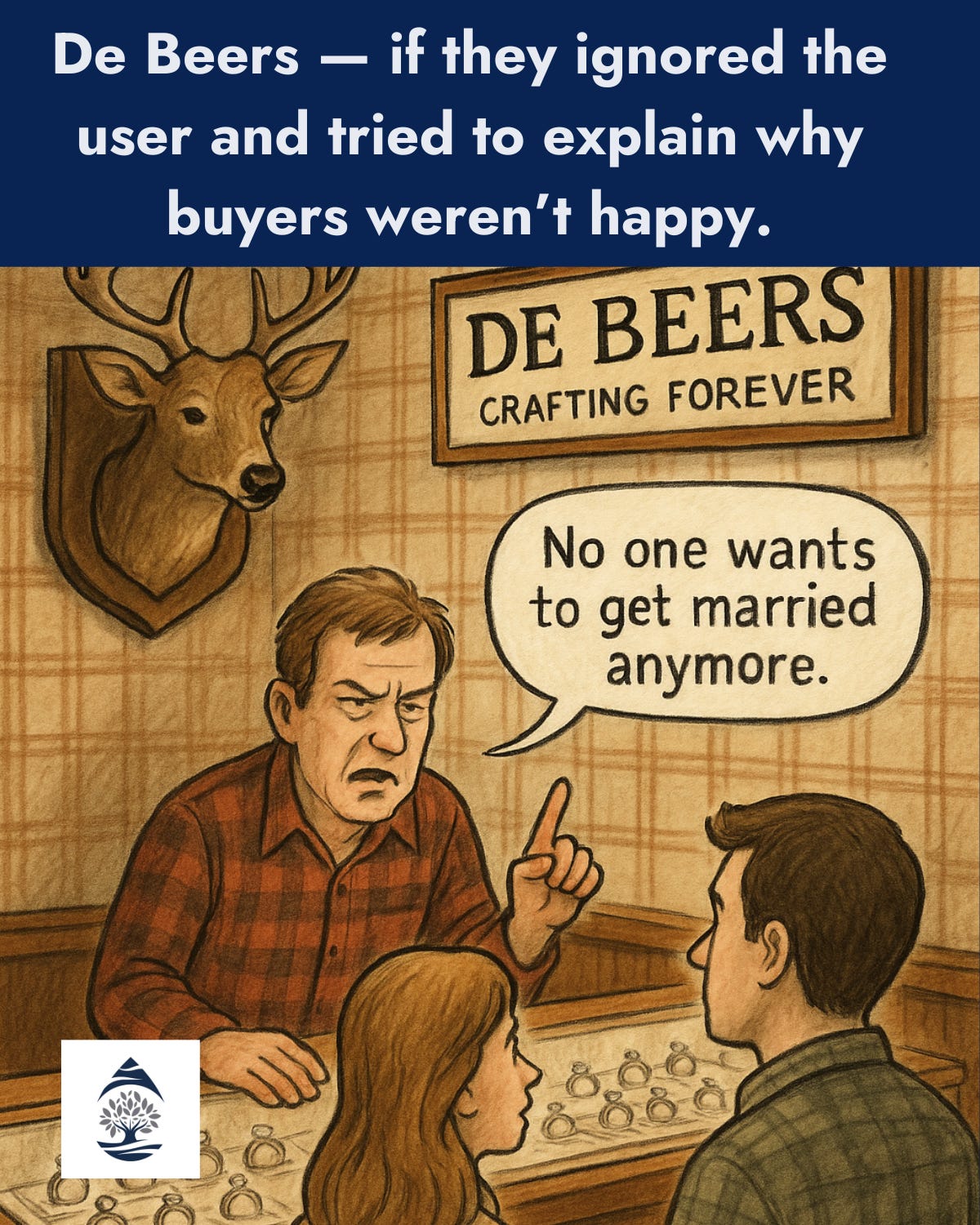
Picture this:
You walk into De Beers to buy an engagement ring.
Instead of elegance and sparkle, you find a rustic hunting lodge—flannel everywhere, mounted animal heads on the walls, and an ornery tough looking man in plaid polishing rings like he resents them.
When you mention it seems slow, he side-eyes your girlfriend and grunts: “No one wants to get married anymore.”
Absurd, right?
It would be, if De Beers had somehow forgotten what kind of market it exists in.
Yet, in the global labor market, the same structural blindness is standard operating procedure.
And cultural traditions around “not knowing the hiring experience” means no one running or operating this market can see the market collapse happening in plain sight.
Who This Is For
This is the opposite of a job seeker problem. It’s system-wide fracture at the heart of the global economy (and multiple national economies):
Workers: ghost jobs, broken signals, algorithmic silence.
Employers: paying for visibility while drowning in noise.
Recruiters/HR: metrics that hide structural failure.
Educators: credentials that no longer guarantee access.
Policymakers: models built on corrupted hiring data.
Communities: instability when work and dignity collapse.
If your world depends on people accessing real work, this includes you.
Core Thesis:
The global labor market is a textbook case of Akerlof’s Market for Lemons and has been for a decade at least.
How is this profitable?
All online markets profit from engagement not solutions. Ghost jobs function as
all clickbait does - an engagement trap.
The market conditions:
Billions of users that can’t opt out (or risk homelessness)
SaaS where usage of the service is the profit, not resolution.
A cultural standard of professionalism where not listening/not knowing/not understanding UX of market profit drivers (job seeking users) is professionalism
Entirely opaque algorithms, untested technological experiences with UX insight and info actively suppressed
Then not only is market collapse entirely plausible, it’s inevitable with these initial conditions from a systems theory or cybernetics standpoint.
So how is it so invisible to those with the power to stop it?
Why No One Sees It:
Employers: Boyfriends Who Slowly Normalized De Beers Becoming a Man-Cave
Employers have been trained not to question the hiring process at all. That was the market standard for 100 years.
In a global market, they expect vendors will fix problems and trust platforms to “find the best candidate” because there are a million applicants out there.
You can see how that version of De Beers developed in seeing how employers have responded to growing market dysfunction.
As noise in the market grew employers turned — predictably — to the same actors every time:
business power players
academia
public policy experts
See if you can spot the slip - because the market distortion is already present in this thinking. (I’ve trained myself to notice — it’s literally my business — and it still catches me. Behavioral conditioning is a beast.)
Shift the frame and try this instead:
If restaurant attendance suddenly got erratic, who would you ask?
People who buy gift cards?
Other people who own restaurants?
the FDA, Health Department, and academics?
The people whose eating habits have changed?
If Disney saw erratic drops in park attendance, who would they interview?
Parents dealing with the park hours and ride schedules?
Theme park owners and nearby businesses?
Theme park historians and former employees?
The kids the park actually exists to delight?
In any functional two-sided market, your answer is always group four, with maybe some insight from groups one or two. Rochet & Tirole were not confusing about the importance of end users in a two-sided market.
But in the online labor market - a market that affects national economies across the globe?
It is never group four — the people whose behavior is actually changing — because we’ve built an entire culture around the idea that “professionalism” means job seekers must not speak.
Why are we violating economic first principals in such a crucial market? My hypothesis: in training ourselves to professionally never talk about hiring processes we actually train ourselves to never think about them.
Are some people aware, being complacent, or acting with malice? Sure! Some people are always doing that everywhere. But the pervasive nature of this error speaks almost to the nature of human cognition.
Half of my empathy relates to my own cognition. This is my business, I have spent 5 intense years on this study and I actively work on this - and I still slip.
Emergence via incentive structure vs malice of intention:
Teenagers don’t generally attempt to make dirty rooms, they just fail to clean them up regularly. If it’s easier to not do it, it’s social tradition for people to not look and not care, and it allows you to get paid more to not clean it up - then why would you?
And that is how an entire labor market collapses in plain sight:
without feedback, without a neutral platform, and without the people driving it even realizing what they’ve broken.
Public Policy + Academia: More Linguists Than Grammar Teachers
I used to imagine policymakers and economists as high-school grammar teachers — enforcing clear rules that came from some mythic land of certainty. Naivety strikes all of us!
But in reality, they operate much more like linguists:
they observe patterns
they describe emergent structures
they document what “is,” not what “should be”
and they are also structurally detached from the people inside the market
When the global labor market moved online, policymakers were thrown into an uncharted digital landscape. And their attention was pulled toward the most visible digital dangers:
fraud
trafficking
identity theft
Against threats like these, “ghost jobs” don’t read as evidence of cybernetic failure growing.
They read as a footnote — a curiosity, not a crisis.
Academics, meanwhile, see the disturbing patterns emerging. But:
they lack the power to intervene
they are trained to stay analytically distant from market actors
and they carry an unspoken cultural assumption:
“Job seekers are unreliable narrators.”
With the ‘experts’ being top-tier professionals trained never to discuss the hiring experience — and therefore trained to see it only through employer-centric lenses — we accidentally conditioned entire academic and policy fields to never even imagine the true impact of hiring intermediaries on economic stability, civic integrity, and democratic institutions.
Job Market Vendors: Switchboard Operators Who Think They Are Bouncers
When hiring moved online, job market operators inherited the employer’s worldview instead of the newspaper’s function. And in doing so, the entire industry lost the plot.
Their job was supposed to be simple:
connect employers with reliably imperfect humans
create clarity, flow, and thus trust
But the internet made the world feel infinite.
So platforms adopted a new identity:
“We’re here to find the perfect candidate.”
Instead of communication and connection, they fell into curation and categorization. And that identity shift is what broke the labor market.
Because:
curation is not their job
filtering is not their job
It’s the De Beers absurdity all over again:
Instead of creating rings and jewelry that girlfriends actually love, they decided to start screening out “girlfriends” they deemed “not wife material.” And in acting like bouncers, they created a hundred billion dollar market centered around employer comfort and identity not labor market functionality.
Platforms chose the wrong market category — and everything downstream reflects that error.
Job seekers aren’t people they have any reason to build trust with, because neither the public, nor public policy, nor academia, nor journalists, nor employers require it. All of those actors - being good professionals - look away.
They don’t think to address job seeker needs because they don’t saw job seekers as users.
They see them as raw material.
And in neglecting the user experience of 95% of the market, the talent industry created:
shelves of empty cereal boxes in a global supermarket that impacts billions of hungry peoples’ ability to eat
rampant spam, labor fraud, and identity theft vectors (LinkedIn makes more by scammers existing when job seekers can’t opt out and employers, the public, academia, and journalists are so unable to do anything but look away.)
algorithmic quicksand that traps qualified applicants
a decade-plus George Akerlof “lemons market” sitting at the base of the global economy - eroding the civic, democratic, and economic stability of every national economy it touches.
The talent industry cannot see job seekers because they cannot see themselves.
Platforms became bouncers in a market that only works if they remain switchboard operators.
And everything downstream — is the consequence of that single category error.
Core Thesis Revisited
This is a cybernetic collapse—a system that has lost the ability to process feedback, adapt, or see itself clearly.
Platforms optimized exclusively for employer experience.
This is the market tell for trillion dollar ongoing vendor failure. Job seekers—the end users in a two-sided market—have no voice, no feedback mechanism, no way to signal when postings are fake, processes are broken, or their time is being wasted.
Of course we have a hundred billion dollar global market in collapse. There was never a reality where a two-sided market created with this structure would succeed.
No one can see this clearly because everyone is operating from cultural tradition around professionalism and incomplete information:
Employers think platforms work (they keep paying)
Platforms think they work (revenue is up)
Policymakers see “applicant volume” and miss that applications mean nothing if they vanish into voids
Job seekers who are desperate don’t have time to integrate what is happening and perform to stay afloat.
The fix isn’t about blaming any single actor.
Blame feels powerful and righteous, but it’s function is disguised complacency. It tells you that you didn’t do anything wrong (emotionally comforting) and so you don’t need to change anything (emotionally and physically comforting).
Blame is NOT economic repair or triage. It’s emotional peace and a return to norm.
Empathy is the opposite. It is irritating because it requires a higher cognitive load and more effort.
Connection creates the space for annoyance, curiosity, frustration, understanding, and thus adaption - aka repair. It doesn’t outsource discernment (detachment) or outsource agency (blame) and thus requires accountability and attention.
It also creates innovation in the process.
We desperately need to repair something here. Feelings feelings is great. Blame and detachment are the trap.
So here’s the real truth. Not a one of us are anything but human in this play.
When employers keep paying for platforms that don’t work, it’s not stupidity - it’s that they don’t see the signal. When journalists, public policy, or academia don’t imagine what’s happening, it’s not malice, it’s training in “professionalism” playing out. When platforms optimize for engagement and screening, it’s not evil - it’s mis categorization of their market role and no one able to tell them because of “professionalism.” When job seekers spam 400 applications, or give up altogether, it’s not laziness - it’s rational response to opacity.
The pragmatic economic fix is about restoring the missing signal: giving the 95% a mechanism to report what they experience, the same way every other functional market does.
The Job Applicant Perspective
Here’s what job seekers need to make informed decisions—the same things any buyer needs:
Transparency about the product: What’s the salary range? What are the benefits? Is this worth the time investment?
Process clarity:
Will this application take 2 minutes or 2 hours, 2 weeks, 2 months, or never?
Which platforms are being used?
ATS systems function - for job seekers - like a payment gate that accepts their resume (credit card). Not knowing what payment gate they are looking at affects their ability to be seen. Also it gives them no opportunity to not choose this type of payment gate and let employers know what works for them.
Visibility into who they’re dealing with: Is this a recruiting agency, a talent firm or a sub-recruiter I am talking to? What’s the reputation of that agency and do I want to engage in this hiring process given the employer has chosen to utilize these people
Here’s a thought: if a job seeker doesn’t want to apply at your company because you hired through Adecco, Greenhouse, Indeed or otherwise - that’s GOOD for you to know. Maybe those aren’t the job seekers for you OR maybe you want a different recruiting firm. It depends. But just because someone likes coffee vs tea doesn’t make one better or worse. It just gives you info as to what works - for you.
Opaque processes are just slot machines for resumes.
The solution for a complex market failure is breathtakingly simple: Let job seekers do what buyers do in every other functional market—review their UX experience.
Anonymous user reviews of job postings create the missing feedback loop. They reveal:
Which postings are real vs ghost jobs
Which processes respect applicants’ time
Which recruiters and platforms deliver what they promise
This isn’t new technology. It’s Yelp for hiring morphing into Google Maps for the labor market. The same reputation system that makes eBay, Uber, and Airbnb work.
At The Job Applicant Perspective we know saving time for one actor saves money/time for the other in any two sided market. The profit is in the pain with one stakeholder. The profit is in the solution with two.
Check the Research
Different fields converge on the same conclusion:
Platform economics
Rochet, J.-C. & Tirole, J. (2003).
Platform Competition in Two-Sided Markets.
Journal of the European Economic Association.Rochet, J.-C. & Tirole, J. (2004).
Two-Sided Markets: An Overview.
MIT Economics Working Paper.Gillespie, T. (2018).
Custodians of the Internet: Platforms, Content Moderation, and the Hidden Decisions That Shape Social Media
Opacity increases inefficiency
Bogen, M. & Rieke, A. (2018).
Help Wanted: An Examination of Hiring Algorithms, Equity, and BiasFuller, J., Raman, M., & Restuccia, D. (2020).
Dismissed by Degrees (Harvard Business School)Autor, D. & Kalleberg, A. (2018).
Precarious Work and the Future of Employment Relations
Two-sided reputation restores signal
Resnick, P. & Zeckhauser, R. (2002).
Trust Among Strangers in Internet Transactions: Empirical Analysis of eBay’s Reputation SystemSundararajan, A. (2016).
The Sharing Economy: The End of Employment and the Rise of Crowd-Based Capitalism
My own work is below. These academically oriented white papers touch on much of what is referenced above, organized specifically around online hiring plus some original economic systems theories of my own. Included also are breakdowns for how I see the interlocking trust architecture system developing with funding.
📄 Full working papers, notes, and references:
Paradigm Restoration NOT Paradigm Shift
The thing to realize here is that up until hiring went online the labor market actually did have two stakeholders. Newspapers lost money for misleading and mistreating the U.S. labor force.
Since going online, that exact opposite has been true. Inefficiency is profoundly profitable.
We need the first type of market again. The question isn’t whether or not that De Beers absurdity is playing out. It’s more, how could it not be with these market incentives and cultural traditions? Why wouldn’t it?
And IF it isn’t, and it costs you nothing to know that except putting a blurb on LinkedIn to send your job seekers that way, why wouldn’t you want to know?
Creating user reviews for job ads isn’t so much about evaluating the relationship with employment, it’s about evaluating the jewelry employers are purchasing to “woo” the labor they seek to acquire.
The global labor market doesn’t need the silence of the labor force in the digital age—it desperately needs their professional voice.
Market repair will come from job seekers doing what users do in every functional market: sharing what they experience.
Anonymous reviews. Real-time feedback. Crowdsourced truth.
Start here → www.thejobapplicantperspective.com
Because the only thing stronger than a broken system is a population that refuses to navigate it blind.
@Sarah Trumble, another bold and brilliant post! You said, "Market repair will come from job seekers doing what users do in every functional market: sharing what they experience.
Anonymous reviews. Real-time feedback. Crowdsourced truth.
Because the only thing stronger than a broken system is a population that refuses to navigate it blind."
This is an interesting take. I am eager to see your following essay on how these hiring platforms have silently inserted themselves between the customer and the client (to siphon revenue from both without any value add). You've outlined the hypothesis, but the real data to mine, and report on, is in the deconstruction of the hiring platforms from the inside out.